For how long was the world flat
Mankind knows the answer. Imagine that
Per this post – right at the start
This observatory is state of the art
It is a “Wide – Field Survey Telescope”
Resurrected from previous work, installed with much hope
It is designed to answer many fundamental questions
With answers we can understand, with the best of intentions
© Forrest Heaton 4 September 2026
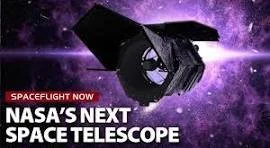
Readers of this blog keep their eyes on what NASA is doing. Thus, many of you may be well ahead of this post. THIS is a biggie. “Biggie” is not a word I use very often, but you get the point. After approximately five years of delays (pandemic impacts, budget/political pressures, engineering modifications), the Nancy Grace Roman Space Telescope was successfully launched 30 August 1926 at 7:26am aboard a SpaceX Falcon Heavy rocket from Kennedy Space Center, Florida.
Nancy Grace Roman was NASA’s first chief of astronomy and (per a nasa.govlisting of the space telescope’s details) is “widely celebrated as the ‘Mother of Hubble’.”
Also per nasa.gov “The Nancy Grace Roman Space Telescope (NGRST) is NASA’s flagship infrared observatory and “was designed to unravel the mysteries of dark energy, dark matter, and exoplanets.” The telescope “captures images 200 times larger than Hubble’s infrared view while retaining equivalent sharp resolution.” It will travel around the sun in sync with Earth, the same way as the James Webb Space Telescope (JWST) operates, all of this roughly a million miles from Earth.
The NGRST was built for entirely different jobs (although with overlapping science goals) than was the JWST. The JWST was designed to “study the earliest light in the universe, observe the formation of stars and galaxies, and search for potential signs of life on distant exoplanets.” (An exoplanet is any planet that exists outside our solar system.) The NGRST “rapidly surveys vast areas of the sky to map large-scale structures.” (Per nasa.gov) NASA’s goal with NGRST is to “solve the mysteries of dark energy, map dark matter and conduct a massive exoplanet census.”
The NGRST has a planned primary mission of five years though it carries enough fuel to potentially operate for an additional five years. It will “observe over a billion galaxies and discover over 20 billion stars”—a rarity!
What have we learned from Hubble? The HST “gathered over 1.7 million observations and clear images across visible, ultraviolet and infrared light since its launch in 1990.” 1.7 million is a huge quantity of data. Imagine the quantity of stark realizations and surprises the NGRST will bring the people of the world with its 200 times larger view than Hubble!
Yes, you (or perhaps your children and grandchildren) have a front row seat for the changing nature of this democracy (painful as it is) but also a front row seat for the answers to many questions eons of humans have shared regarding our planet, universe(s?) and solar system!
NASA calls this “a civilization scale experiment!”
Did you miss seeing the launch? If so, go to nasa.gov and select seeing the launch. You will witness a new world (or worlds?) opening to us. What you will be witnessing is ”something scientifically impactful for all humanity”. Talk about a rarity!
It will take approximately three months for the NGRST to travel the million miles to reach it’s orbit around the sun. During that time NASA is turning the equipment on and readying the telescope to begin it’s work on arrival. NASA feels it will “generate never-before seen pictures that will revolutionize our understanding of the universe.” And you will be in a great position to understand a portion of the 1.4 terabytes of scientific data it will download every day.